
Clear Pathways, an initiative of Peg’s Foundation, has launched its Adult Mobile Crisis (AMC) Alternative Payment Model (APM) Demonstration. After studying how mobile crisis services operate and are funded across Ohio, the organization is now partnering with providers to test new standards and payment approaches that could make these services more sustainable.
The Demonstration will work with select Ohio AMC providers to test new payment approaches and assess whether a value-based payment model can improve the quality and financial sustainability of adult mobile crisis services.
Building a Sustainable Foundation
Funding is the single greatest barrier to effectively implementing and sustaining mobile crisis services in Ohio. In 2025, Clear Pathways conducted a series of in-depth interviews with Ohio providers—spanning urban, suburban, and rural areas, and a range of service delivery models—to understand their mobile response program operations and assess alignment with national best practices. Clear Pathways also analyzed the providers’ cost of operating mobile response services, accounting for geographic factors, variations in service models, and program-specific differences.
The findings were consistent and compelling: nearly every provider interviewed described significant financial strain, with most delivering services at a financial loss. Medicaid and commercial insurance reimbursements cover only a small fraction of expenses, while ADAMH Boards typically provide substantial funding to fill the gap. Nearly every provider also reported challenges recruiting and retaining qualified staff—underscoring that sustainable funding is a prerequisite for appropriate, qualified staffing.
These findings are helping to guide Clear Pathways’ work through the Demonstration with participating providers to identify sustainable funding approaches that can support mobile crisis services across Ohio.
Anticipated Benefits
For AMC providers, Alcohol, Drug Addiction, and Mental Health Boards (ADAMH) Boards, and the communities they serve, the Demonstration is designed to achieve the following:
- Optimize insurance coverage and reimbursement to help providers diversify their payer mix and reduce reliance on time-limited local funding
- Reduce avoidable hospitalizations and criminal legal system involvement
- Improve follow-up and connection to ongoing care for individuals after a mobile crisis encounter
- Prepare providers for value-based payment (VBP) arrangements with Medicaid managed care organizations (MCOs) and commercial payers
- Standardize data collection and improve staffing and mobile crisis response models across the state
Participating Counties
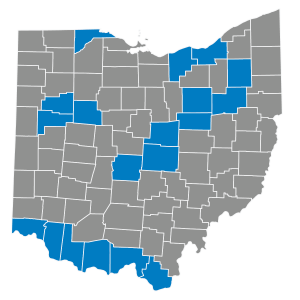
The Demonstration includes 12 AMC providers across 19 Ohio counties, reaching nearly half of the state’s population. Providers were selected based on readiness in three areas: leadership, data, and finance. Together, they offer a representative mix of communities and provider contexts for testing the core APM measures. The participating counties are:
- Adams County
- Allen County
- Auglaize County
- Brown County
- Clermont County
- Cuyahoga County
- Franklin County
- Hamilton County
- Hardin County
- Holmes County
- Knox County
- Lawrence County
- Licking County
- Lorain County
- Lucas County
- Portage County
- Scioto County
- Stark County
- Wayne County
A Three-Pillar, Multi-Year Demonstration
The Demonstration is built on a two-way commitment between Clear Pathways and each participating provider. Over the next three years, engaged providers will work with Clear Pathways across three interconnected pillars:
- Program Standards: Co-develop service standards that define the core elements of AMC care and can serve as an actionable framework for the field.
- Data Foundation: Inform a shared data foundation that supports fair payment, performance monitoring, and a clearer understanding of what is needed to sustain AMC services.
- Value-Based Payment Readiness: Provide insight into what value-based payment means in practice for AMC providers and what support is needed to prepare for it.
The Three-Year Arc
- Year 1 (2026–2027): Guide providers through baseline data collection and capacity building
- Year 2 (2027-2028): Build and test the initial value-based payment model.
- Year 3 (2028-2029): Refine the APM and use findings to inform statewide policy and funding decisions
“Mobile crisis teams are an essential part of the behavioral health crisis continuum. We have seen impacts on communities when mobile crisis teams stop operations due to funding gaps. Together with participating providers, we are working to build a sustainable funding path that improves care for people experiencing a behavioral health crisis,” says Clear Pathways Executive Director Alicia D. Smith.
A National Network and Plans for Expansion
The Adult Mobile Crisis Alternative Payment Model Demonstration is a component of the Behavioral Health Emergency Response Initiative (BHERi), a multi-state effort coordinated by NYU’s SCALE + Lab at The Marron Institute of Urban Management and funded by Blue Meridian Partners, with additional support from The Pew Charitable Trusts. Clear Pathways serves as Ohio’s implementing partner for BHERi, with other implementing partners in Michigan and Texas. This involvement gives Ohio communities the opportunity to learn from and contribute to a growing body of national evidence on effective crisis response, while bringing national expertise and resources back to the state.
Findings from this Demonstration will lay the groundwork for statewide and national policy recommendations to establish sustainable funding mechanisms for adult mobile crisis services. By optimizing insurance coverage and reimbursement types, communities can strengthen crisis services for the people who need them most.
Technical Assistance to Guide Implementation
Each provider engaged in the Demonstration receives a wide range of technical assistance across four key areas. Providers will benefit from the following:
- Demonstration support, giving providers direct, ongoing access to the project team with questions and troubleshooting as they work through the demonstration.
- Planning and implementation support, allowing providers to translate program standards and payment model requirements into day-to-day operational practice.
- Learning and resources, offering providers targeted learning opportunities and a centralized, continuously updated repository of demonstration materials.
- Connection and collaboration, providing a platform for peer-to-peer learning among providers, boards, and managed care networks.
Providers can also request tailored support for needs not already covered by these offerings.
Stay Connected
- Email us with questions at MobileCrisis@pegsfoundation.org
- Follow us on LinkedIn for updates, resources, and opportunities
- Sign up for our email list to receive news and announcements
About Clear Pathways
Clear Pathways is an initiative of Peg’s Foundation, the largest philanthropic mental health funder in Ohio, investing in scalable systems change efforts that improve behavioral health crisis response across Ohio and beyond. Clear Pathways assists local, state, and national partners with accelerating the implementation of best-practice crisis response to reduce reliance on jails and hospitals, ensuring adults experiencing a behavioral health crisis have a clear path to getting person-centered help. Learn more at https://clearpathwayscollaborative.org.